News
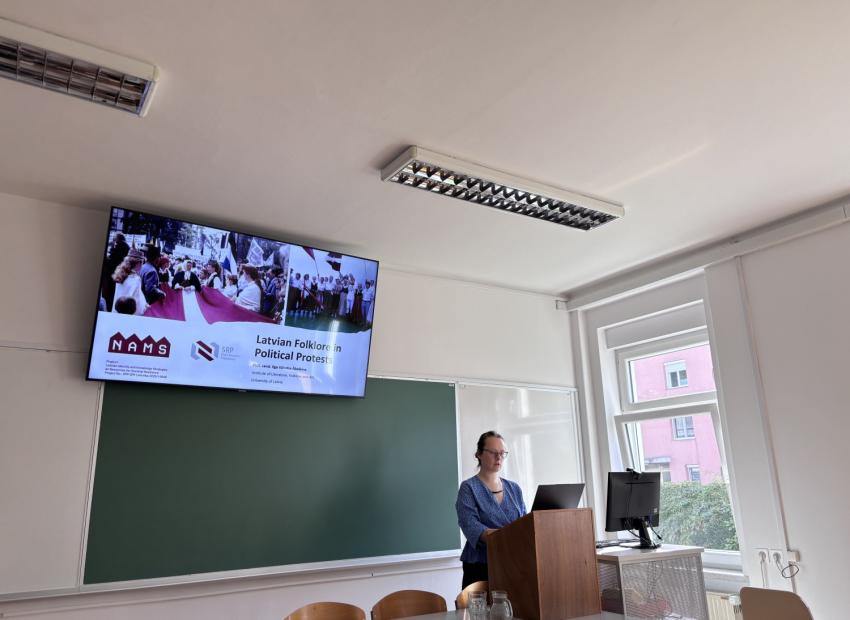
Ilga Vālodze Ābelkina participates in the Young Folklorists’ Conference in Ljubljana
Read more
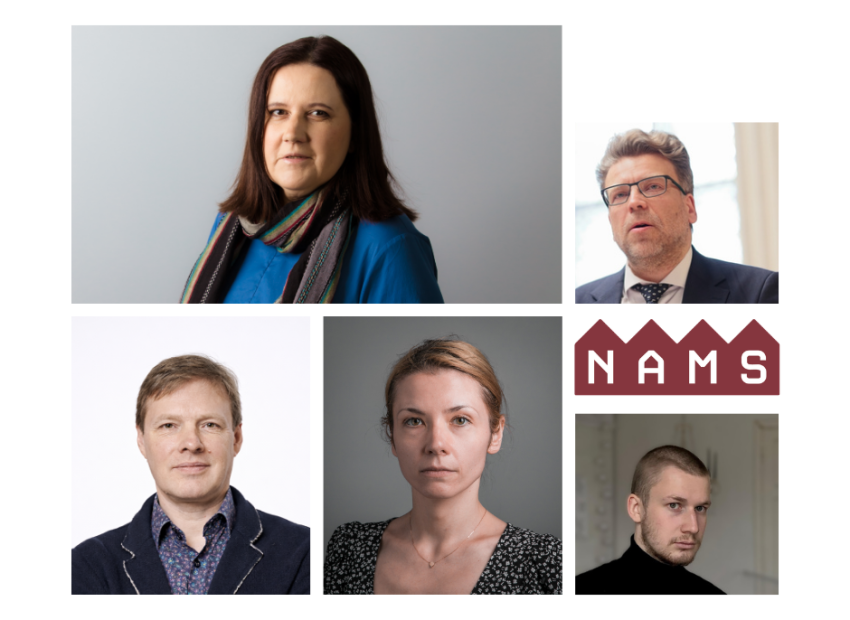
The project "NAMS. Latvian Identity and Knowledge Strategies as Resources for Societal Resilience" (VPP-IZM-Letonika-2025/1-0008) is implemented within the framework of the State Research Programme “LETONIKA for the Development of a Latvian and European Society”.
The project focuses on the question of how Latvian identity functions as a resource for societal resilience in conditions of geopolitical uncertainty. Identity in the project is perceived not as a fixed essence, but as a historically layered and discussed "living house" (‘NAMS’ in Latvian) whose meanings are formed by epistemic pluralism – the coexisting academic, vernacular, spiritual, creative, and political logics of knowledge. Identity resources, risks, and visions for the future will be explored through archival work, interviews, field research, critical disciplinary history, analysis of vernacular knowledge and spirituality, and a national survey.
The project particularly highlights the folklife sphere as a resource for ethnic identity, which has been continuously shaped by the interaction of state institutions, academic disciplines and popular practices. Researchers will analyze how folklore and heritage are activated, commercialized, and reconfigured to respond to the needs of modern society. Latvian identity and cultural heritage are also viewed in the context of national security, studying the resources of the Latgale (Eastern Latvia) cultural spaces to enhance their readiness to adapt its infrastructure to crisis situations and be proactive strategic communities.
The project will result in four books, 18 scientific articles, and nine new data sets. The research findings will be summarized in reports for policymakers and implementers. In collaboration with communities and policymakers, safety guidelines for cultural spaces and heritage communities will be developed. The project also includes an extensive public engagement and science communication program: conferences and thematic conference sessions, lectures and discussions, cooperation with educational and heritage institutions, development of new digital solutions, cooperation with various neighborhoods, regions, communities, and creative professionals. Thus, the project will have a twofold impact: conceptual – by updating sources and vocabulary of Latvian identity for the participation in global academic debates; and practical – by strengthening democratic knowledge cultures, social resilience and heritage maintenance.
Project partners:
Institute of Literature, Folklore and Art, University of Latvia (ILFA, UL)
Faculty of Humanities, University of Latvia (FH, UL)
Latvian Academy of Culture (LAC)
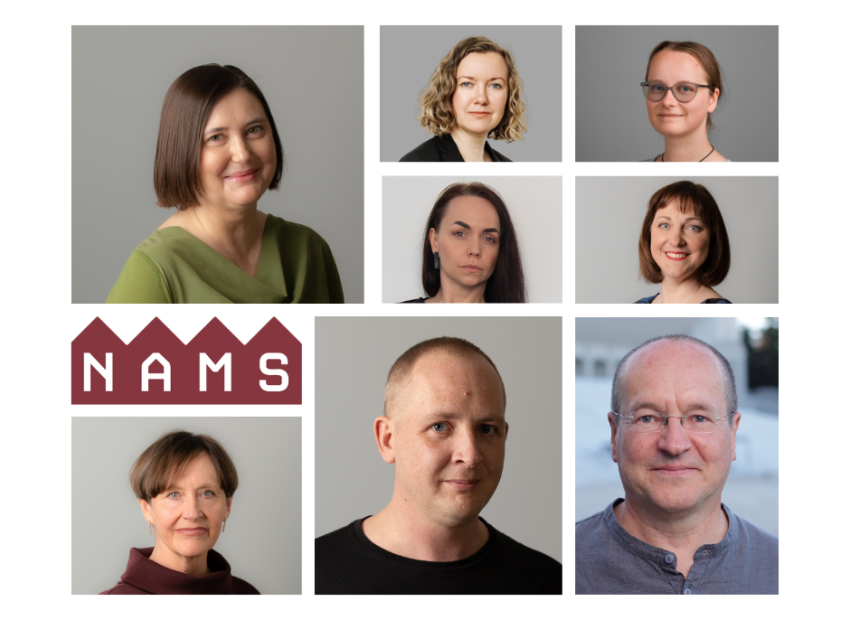
Project team:
ILFA, UL: Dace Bula, Sandis Laime, Digne Ūdre-Lielbārde, Agita Misāne, Klāvs Sedlenieks, Ieva Vīvere, Rita Zara, Anna Griķe, Aigars Lielbārdis, Gatis Ozoliņš, Ginta Pērle-Sīle, Jānis Krēsliņš Jr., Ilga Vālodze Ābelkina, Sindija Anča
FH, UL: Raivis Bičevskis, Sanita Reinsone, Valdis Muktupāvels, Elvīra Šimfa, Simona Kaščejeva, Tomass Stepiņš
LAC: Anda Laķe, Rūta Muktupāvela, Ieva Vītola, Lote Katrīna Cērpa
Project leader: Ieva Weaver (Vīvere)