News
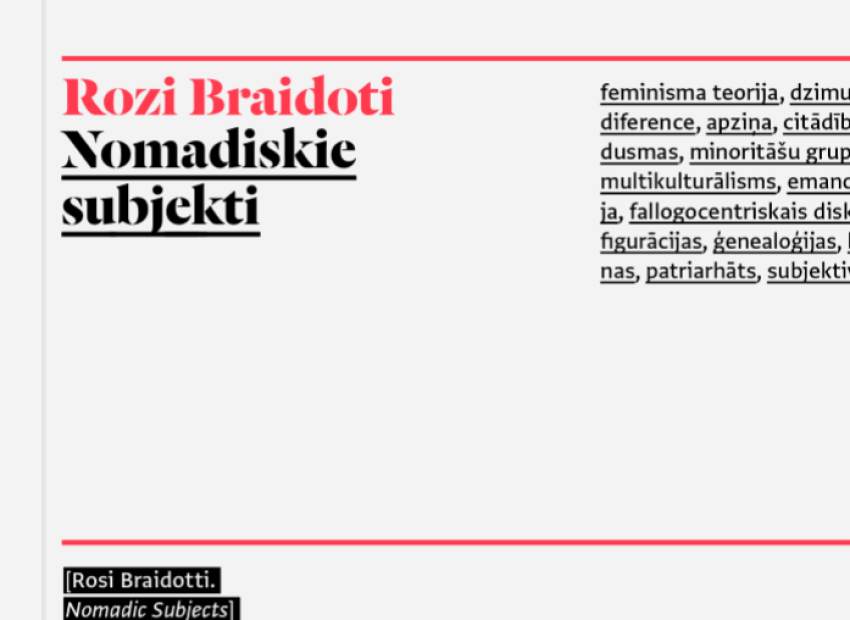
Ieva Melgalve’s article "Translation as a Nomad"
Read more

The aim of this project is to investigate local manifestations of international anti-gender discourse in public space and literature, with particular attention to recent and upcoming political and economic developments. Anti-gender mobilization seeks to re-establish binary gender categories based on ‘natural’ gender roles and the ‘natural family’, grounded in patriarchal and masculinity-driven worldviews. This movement unites otherwise disparate groups – Christians, proponents of secular conservatism, far-right activists, and even self-proclaimed centrists – claiming to speak on behalf of the so-called silent majority or “normal people.” To achieve its political goals and build transnational online communities while suppressing opponents, the movement employs a broad range of discursive strategies.
Previous research has demonstrated that anti-gender mobilization takes distinct forms across different contexts, utilizing varying discursive tools depending on the country and cultural setting. However, there is a lack of academic research on this phenomenon in Latvia. This project aims to fill this gap by analysing the positions and discourse of anti-gender mobilization both in public discourse and literary texts over the past decade, alongside conducting case studies of key actors in this mobilization. One of the core goals of the project is to enhance both academic and public understanding of the intersections between seemingly unrelated discourses at both the local and international level.
Photo: Valsts policija.