
From traditional evening gatherings to a digital game – researchers invite everyone to solve Latvian folk riddles
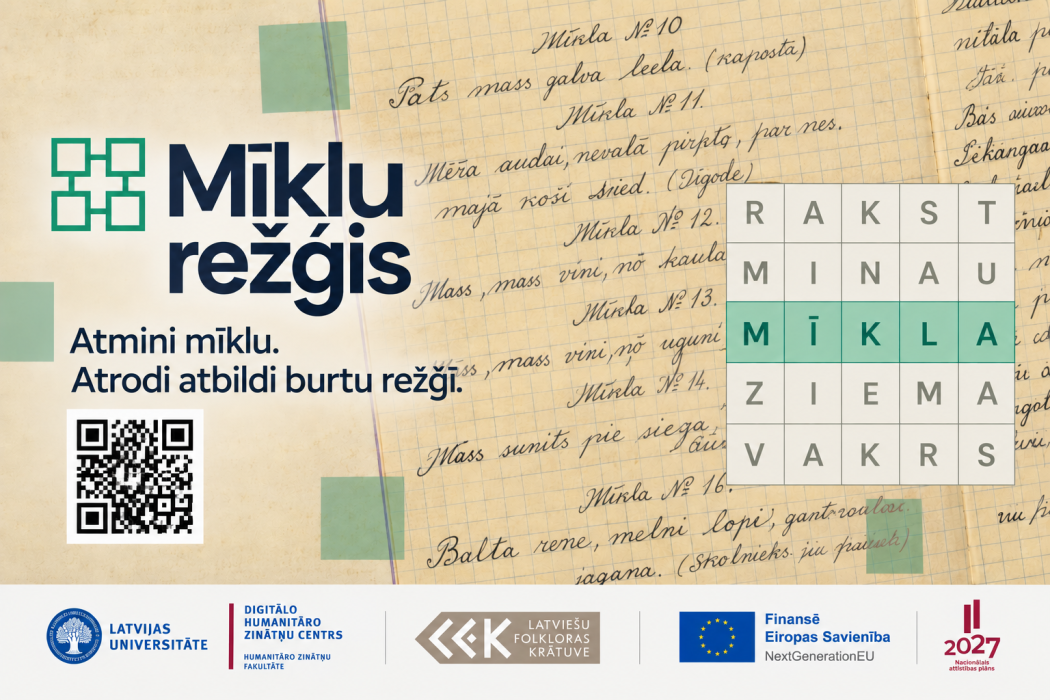
As the darkest time of the year approaches and the Christmas season draws near, the Digital Humanities Centre of the University of Latvia (UL) and the Archives of Latvian Folklore at the UL Institute of Literature, Folklore and Art invite everyone to rediscover an old Latvian tradition – riddle-solving. To offer an engaging and contemporary way of exploring folklore heritage, a digital game called “Mīklu režģis” (Riddle Grid) has been developed. Players are invited to test their ingenuity by solving traditional Latvian folk riddles and finding their answers in a letter grid. The game is suitable for individual play as well as for families, friends, and players of all ages.
In traditional Latvian culture, solving riddles was not only a form of entertainment but also a way to test one's ingenuity, develop thinking skills, and spend time together. This activity was particularly important during autumn and winter evenings, when people gathered for vakarēšana – traditional evening gatherings where they worked together on household tasks, told stories, and challenged one another with riddles.
The Archives of Latvian Folklore at the UL Institute of Literature, Folklore and Art preserves accounts of riddle-solving traditions from different regions of Latvia. One folklore record states: “Neighbours would come together for evening gatherings to solve riddles. They spun yarn, knitted, and solved riddles in between.” The same account notes that riddles were mainly solved in winter, when evenings were long and dark, and that over time children also began to participate alongside adults.
Today, this tradition can be continued in a digital environment. The game “Mīklu režģis” features authentic Latvian folk riddles from the digital archive of the Archives of Latvian Folklore, Garamantas.lv. Players must solve each riddle and find the correct answer in a letter grid. The game combines the imagery of traditional folklore with challenges that test observation, logical thinking, and ingenuity.
“Mīklu režģis” offers several game modes, including individual riddle-solving, a daily riddle, competitions among friends or family members, and a version specially adapted for children. Players can simply test their ingenuity and have fun, but they can also participate in research by not only solving riddles but also sharing their thoughts and knowledge about them. The data collected through this participation will help folklore researchers better understand how traditional riddles are perceived and interpreted today.
The digital game is part of ResearchGames.eu, an initiative of the Digital Humanities Centre at the University of Latvia that aims to develop research-based games and make scientific knowledge and cultural heritage more accessible to the wider public. “Mīklu režģis” demonstrates how folklore materials collected by researchers and preserved in archives can find new life in a digital environment while encouraging interest in Latvian oral traditions.
About the Project
The game “Mīklu režģis” is being developed by the Digital Humanities Centre of the University of Latvia within the framework of the “ȬPEN” project (No. ZDA-LIP 2025/2).
The Latvian folk riddles featured in the game are sourced from Garamantas.lv, the digital archive of the Archives of Latvian Folklore at the UL Institute of Literature, Folklore and Art.
The public engagement campaign is implemented within the framework of the project “University of Latvia and Institutes in the European Research Area – Excellence in Research and Cooperation” (No. 1.1.1.5/3/25/I/011).