
Eva Eglāja-Kristsone takes part in a discussion on cultural relations at the Museum of the Occupation of Latvia
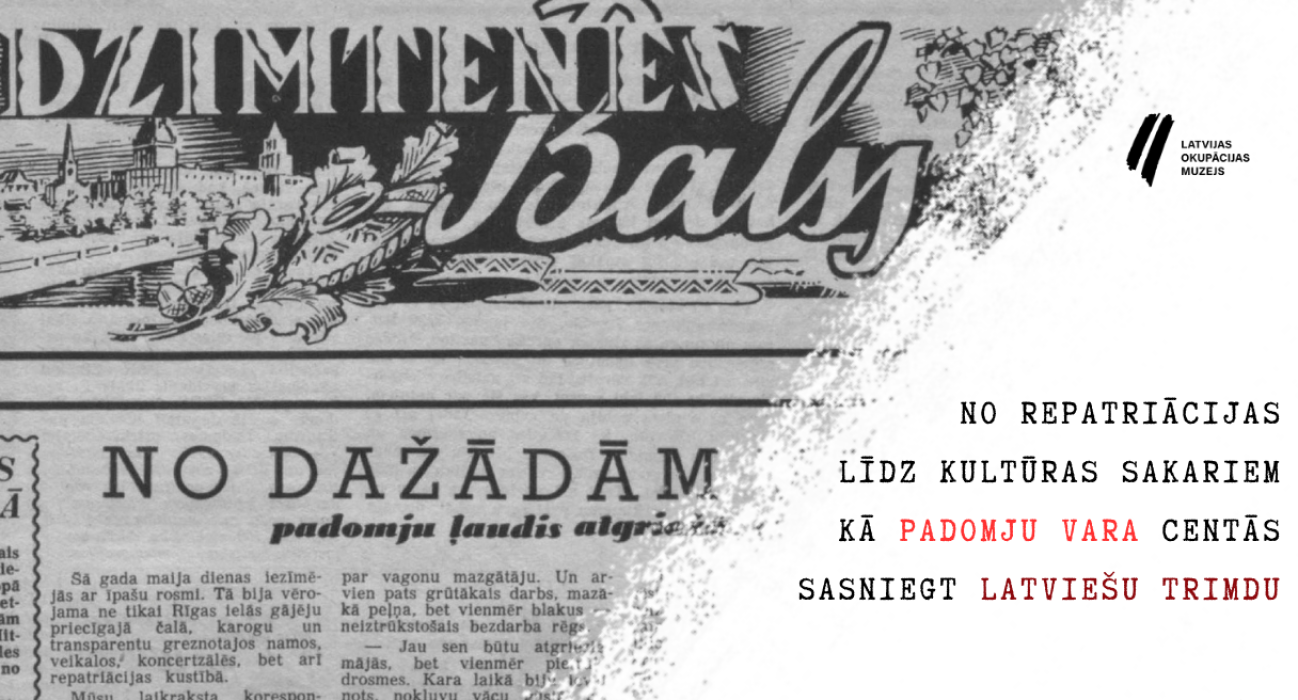
Why did cultural ties become one of the instruments of this policy? What did these contacts mean to the people involved?
On Wednesday, 14 October, at 5:00 p.m., the Museum of the Occupation of Latvia will host a discussion on repatriation and cultural ties between historian and researcher Lilita Zaļkalne and literary scholar Eva Eglāja-Kristsone, Director of the Institute of Literature, Folklore and Art at the University of Latvia. The discussion will be moderated by Valda Liepiņa, Chair of the Board of the Occupation Museum Association of Latvia.
After the Second World War, the Soviet authorities sought to persuade Latvians living outside Latvia to return. Initially, the main emphasis was on repatriation. However, these efforts failed to produce the desired results, and over time increasing attention was devoted to establishing contacts with Latvians in the West, particularly through culture.
The first attempts to encourage Latvians to return began in the immediate post-war years. These efforts took place in displaced persons (DP) camps and later in the countries where Latvian refugees had settled, as well as through Soviet embassies. Soviet embassy officials in Sweden visited Latvians in their homes and encouraged them to return. Elsewhere, figures such as Zenta Mauriņa and Valts Pūce were also approached. What do we know about the attempts to persuade them to “come home” and about their subsequent fates? How different could the Soviet authorities' promises of a return to the “homeland” be from the reality people experienced after arriving in Soviet Latvia?
Repatriation did not bring the results the Soviet authorities had hoped for. They therefore had to find other ways of reaching the Latvian exile community.
In the mid-1950s, a new repatriation campaign was launched. This period saw the emergence of the notorious publication Dzimtenes Balss (Voice of the Homeland), which encouraged Latvians abroad to return to Latvia and maintain ties with their homeland. In 1961, the Latvian branch of the Committee for the Promotion of Repatriation and Cultural Relations with Compatriots Abroad was established. In 1964, it was reorganised as the Latvian Committee for Cultural Relations with Compatriots Abroad. Officially, the Committee was responsible for maintaining cultural ties with Latvians living outside Latvia. But what lay behind its activities?
From the 1960s onwards, such contacts became increasingly important. Meetings, correspondence and visits took place, and travel began in both directions. Latvians in exile visited Latvia, while people from Soviet Latvia travelled to the West. Those involved included writers, musicians, scholars and other cultural figures.
What did “success” mean in this context, and for whom?
Eva Eglāja-Kristsone will explore this question by examining cultural relations with the Latvian exile community and how these contacts functioned in practice. Particular attention will be paid to the 1970s and 1980s, when contacts with Latvia sparked debates, disputes and even divisions within Latvian exile communities.
Lilita Zaļkalne will examine the political and historical background of repatriation policy, including post-war attempts to encourage repatriation, the campaign of the 1950s, and the subsequent shift towards other methods through which the Soviet authorities sought to influence Latvians living abroad.
The discussion will be moderated by Valda Liepiņa, who was born and raised in Melbourne and was actively involved in the Latvian community in Australia. Although separated by time and distance, the so-called cultural contacts also left a lasting impact on her own life.
The event is open to everyone interested in the subject.