
Discussion: rock music in Soviet Latvia as an expression of counterculture
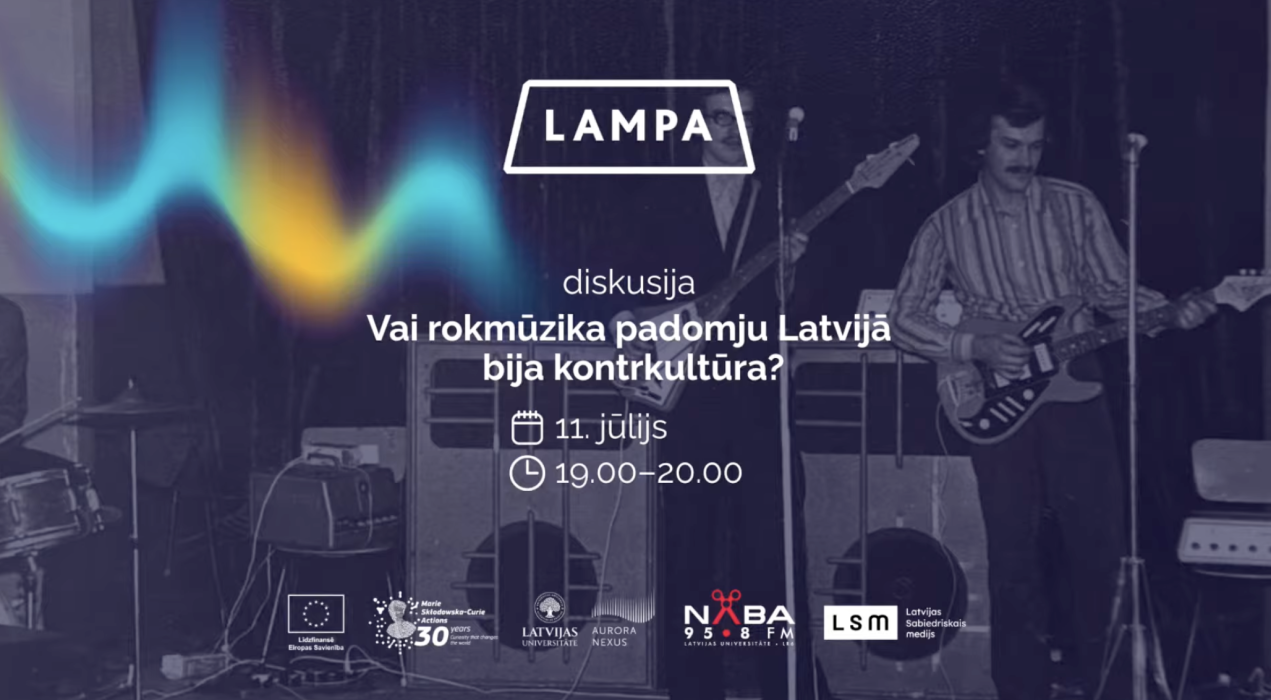
At a Science Café discussion organised by the University of Latvia during the LAMPA Festival 2026, musician and researcher Reinis Jaunais moderated a conversation about the role of rock music in the Latvian Soviet Socialist Republic (Latvian SSR). The central question was whether performing rock music during the Soviet era could be considered a conscious expression of counterculture, or whether young people's desire for self-expression was unrelated to opposition to the authorities.
Musicologist and professor Boriss Avramecs believes that rock music was undoubtedly an expression of counterculture. At a time when the media was entirely controlled by the state, even simply imitating Western hits (early Latvian rock bands performed covers of rock and roll songs, while original rock compositions emerged later) carried the idea of freedom and offered an alternative to official ideology. “In a situation where we all lived almost as if in a concentration camp, this music itself brought us something completely opposite. It was freedom,” Avramecs emphasised during the discussion. At the same time, the professor believes that “real” rock music should be distinguished from the music performed by officially recognised, state-approved “vocal-instrumental ensembles.”
Historian Kaspars Zellis explains that the authorities initially regarded young people's enthusiasm for Western popular music as a temporary problem. The institutionalisation of repertoire control reached its peak in the 1970s, when a fairly comprehensive and sophisticated control mechanism was introduced: the so-called tariff assessment reviews, through which musicians and ensembles were officially evaluated and approved. In 1983, a controlled platform was also established for rock bands that had not passed these assessments: the so-called Riga Rock Club, which operated under the direct authority of the Riga Komsomol and the indirect supervision of the KGB. Avramecs added that the Soviet security officers understood very well that it was better for these activities to take place in a familiar location where both musicians and audiences could be photographed or filmed.
Musician, event organiser, and art exhibition curator Guna Kalnača explains from personal experience that, in the 1970s, playing in provincial music ensembles was not perceived as a conscious act of resistance. It was simply a form of self-expression for young people and a way to spend their free time together. Nevertheless, musicians were forced to operate within the system by participating in official assessment reviews and complying with requirements to include music by Soviet composers in their repertoires. Kalnača emphasises that memories of political repression were deeply embedded in families at the time: “We had all been prepared for the fact that we had to live, to survive, to stay alive, and God forbid that we should end up where our parents or grandparents had ended up. This was deeply ingrained in us.”
Music publisher and DJ Raimonds Mežaks outlines the difficulties involved in compiling collections of early rock music recordings. Many recordings by independent bands have not survived, particularly those made before the mid-1980s. The security services continued to monitor and influence musicians even during the second half of the 1980s.
Perhaps what is later described as counterculture is not always a conscious form of protest. Instead, it may begin as a desire for a normal life and freedom of self-expression, which, under an authoritarian regime, automatically becomes a threat to those in power.
Although the Soviet regime systematically attempted for decades to influence young people's musical tastes, reconcile contemporary international popular music with communist ideology, and create an obedient “Soviet musician,” music itself became an important unifying force during Latvia's National Awakening (Atmoda).
Subcultures and specific niche music genres also exist in contemporary society. Examples include heavy metal, punk rock, and noise music, which distance themselves from mainstream popular culture for aesthetic and sometimes political reasons.
The full recording of the Science Café discussion from the LAMPA Festival is available on the University of Latvia's YouTube channel.
The discussion series “Aurora Nexus FM / Radio NABA Studio” was organised as part of the University of Latvia project “Aurora Nexus: Connecting People, Science and Art” (Project No. 101305570), funded by the European Commission under the “MSCA and Citizens: European Researchers’ Night and Researchers at Schools 2026–2027” programme.
