
Conference recap: literature as a space for encounter
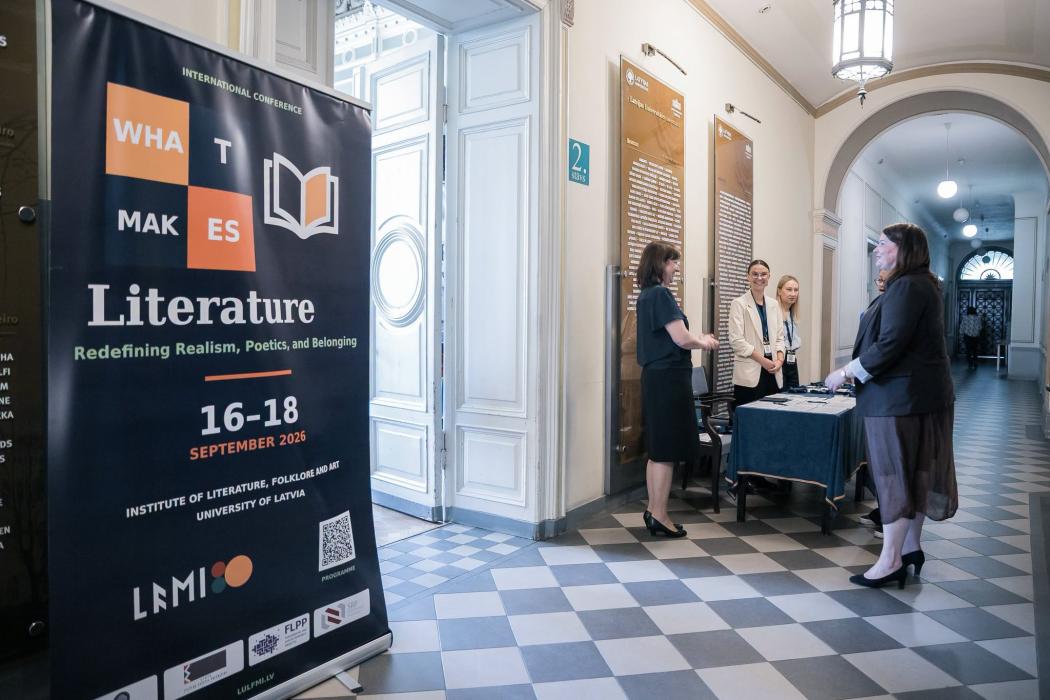
The international conference “What Makes Literature? Redefining Realism, Poetics, and Belonging”, organised by the Institute of Literature, Folklore and Art of the University of Latvia (ILFA), has concluded. Dedicated to the 80th anniversary of ILFA, the conference took place in Riga from 16 to 18 September. The programme featured 66 papers presented by literary and cultural researchers from Latvia and seventeen other countries.
The question at the heart of the conference title — what makes literature? — was deliberately broad. It invited participants to reconsider both the conditions under which literature is created and interpreted and its capacity to shape identity, community, and cultural memory. Conference participants explored the role of language and form, the relationship between writers and readers, literary institutions, and historical contexts. In papers and discussions, literature emerged as a form that simultaneously preserves experience, challenges established assumptions, and makes it possible to speak about things that are otherwise difficult to articulate.
In her opening address, Eva Eglāja-Kristsone, Director of ILFA and co-organiser of the conference, also outlined the idea behind the event:
“When we began planning these three days, we wanted to create a meeting place for ideas that do not always enter into dialogue with one another. Realism, poetics, and belonging provide common ground for questions concerning memory, identity, colonial and post-Soviet experience, the environment, digital culture, reading, and public space.”
The conference was also opened by Guntars Kitenbergs, Vice-Rector for Research at the University of Latvia, who highlighted ILFA’s distinctive place within the University’s research environment, the institute’s international recognition, and the importance of the humanities to the University’s overall development. Svend Erik Larsen, Emeritus Professor at Aarhus University and a representative of the European Academy of Sciences, Humanities and Arts, Academia Europaea, emphasised the importance of international scholarly cooperation and the circulation of ideas, as well as literary studies’ capacity to transcend the boundaries of countries, languages, and individual research traditions. The opening addresses established the institutional and international framework of the conference, connecting ILFA’s 80 years of experience with a perspective on the future development of the field.
From the History of Realism to Digital and Environmental Humanities
The conference was structured around four interconnected thematic strands. These explored the development of realism in literature, from its prehistory to its transformations in the 20th and 21st centuries; concepts of belonging, with an emphasis on contemporary literary trends and the complex legacy of the 20th century; questions of poetics, with particular attention to the forms of poetry, prose, and drama; and the role of digital methods in contemporary humanities research.
Although the conference was centred on literary studies and its methodological diversity, interdisciplinary research also played an important role. Literature was considered in relation to philosophy, history, memory studies, the environmental humanities, theatre, music, digital culture, and the sociology of reading. Questions concerning the place and role of the humanities in 21st-century scholarship repeatedly came to the fore, as did their capacity to critically interpret processes of social, technological, and environmental change.
The conference’s keynote lectures included a presentation by Riikka Rossi of the University of Helsinki, who examined the relationship between realism, naturalism, and emotion in Nordic literature; Rosa Mucignat of King’s College London, who addressed realism in so-called minor languages; and Dirk Göttsche of the University of Nottingham, who explored the relationship between realism and the politics of memory in German literature, examining competing narratives of the Napoleonic Wars across two centuries.
The geographical and thematic breadth of the programme brought together perspectives from the study of Nordic, Baltic, Central European, Balkan, Western European, Latin American, and Asian literatures. Papers addressed the history of Baltic realism and socialist realism, narratives of destruction and ecological crisis, migrant literature, memories of the Gulag, national identities, animist realism, and the transformation of literature in digital environments.
A Dialogue Across Generations and Experiences
The presence of researchers from different generations was an important feature of the conference, making it a productive and inspiring meeting place. In his opening address, conference co-organiser Benedikts Kalnačs emphasised:
“Alongside distinguished specialists with many years of research and administrative experience, the conference brought together numerous mid-career scholars who are at the height of their careers and are devoting their energy and work to the use of new, innovative methods and the enrichment of the research environment, as well as postdoctoral researchers and doctoral students whose research topics are shaping the contours of tomorrow’s scholarship.”
The diversity of perspectives made the discussions in the conference sessions and informal conversations particularly rich. International guests and Latvian colleagues also praised the organisation of the event, as well as its open and creative atmosphere.
The conference’s international organising committee comprised Eva Eglāja-Kristsone, Benedikts Kalnačs, Jānis Oga, Anda Baklāne, Jeanne E. Glesener, Zanda Gūtmane, Petra James, Mindaugas Kvietkauskas, and Maris Saagpakk. The ILFA team was responsible for the day-to-day organisational and technical work. The conference was supported by the State Culture Capital Foundation, the Live Riga programme for co-financing business events of the Riga City Municipality, and the University of Latvia.
ILFA was represented at the conference by Kitija Balcare, Dace Bula, Pauls Daija, Inguna Daukste-Silasproģe, Elvis Friks, Elīza Paula Graudiņa, Māra Grudule, Ilze Jansone, Benedikts Kalnačs, Zita Kārkla, Paula Lāce, Ilze Ļaksa-Timinska, Agita Misāne, Jānis Oga, Artis Ostups, Ginta Pērle-Sīle, and Madara Stāde. The institute’s researchers presented papers covering a broad range of topics, from the beginnings of Latvian realism, exile poetry, and the culture of the late Soviet period to ecocriticism, dramaturgy, digital literature, public humanities, and contemporary reading practices.
Collaboration Between Two Research Projects
The conference “What Makes Literature?” was organised through a collaboration between two projects supported by the Latvian Council of Science. It formed part of the State Research Programme “Letonika” project "Latvian Literature as Belonging: Personalities, Poetics, and the Public Sphere" (LITBEL, project No. VPP-IZM-Letonika-2025/1-0006), led by Eva Eglāja-Kristsone, as well as the project "Reclaiming Latvian Realism: Literary Innovation as Identity Quest” (REALT, project No. lzp-2024/1-0341), supported by the Fundamental and Applied Research Projects programme and led by Benedikts Kalnačs.
Both projects are being implemented at the Institute of Literature, Folklore and Art of the University of Latvia. Their collaboration made it possible to place Latvian and Baltic literary experience within a broader international discussion, while also demonstrating that realism, poetics, and belonging are not separate fields of research. They intersect in questions concerning history and the present, aesthetics and ideology, individual experience and community, national literatures and the circulation of world literature.
The conference demonstrated that the strength of literary research lies in methodological precision, diversity of perspectives, and a willingness to engage in dialogue across disciplinary, linguistic, national, and generational boundaries. The three days in Riga may not have provided one definitive answer to the question of what makes literature, but they offered something perhaps more valuable: new ways of asking the question and new interlocutors with whom to continue searching for answers.