
Researchers at the Spatial Humanities 2026 Congress in Portugal
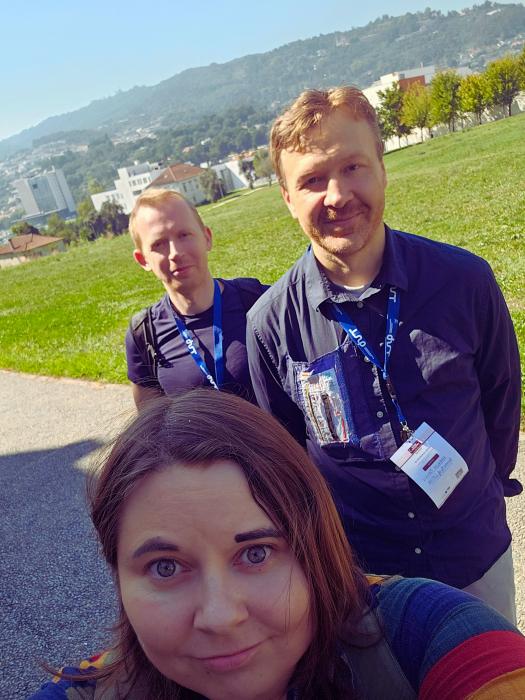
From 23 to 25 September, the international Spatial Humanities 2026 Congress, “Artificial Intelligence and Geotechnologies for Human Experiences”, is taking place at the University of Minho in Braga, Portugal, bringing together nearly 100 researchers from countries around the world. The Congress focuses on the use of geospatial technologies, artificial intelligence, and digital methods in humanities research.
Latvia is represented at the Congress by Haralds Matulis, researcher at the Institute of Literature, Folklore and Art of the University of Latvia (UL ILFA); Ilze Ļaksa-Timinska, researcher at UL ILFA and senior expert at the Digital Humanities Centre, Faculty of Humanities, University of Latvia; and Viesturs Vēveris, PhD student at the UL Faculty of Humanities Digital Humanities Centre.
The three-day programme features workshops, keynote lectures, and parallel paper sessions exploring spatial humanities, digital collections, applications of artificial intelligence, spatial narratives, mobility, cultural heritage, and other topics.
At the Congress, Haralds Matulis, Ilze Ļaksa-Timinska, and Viesturs Vēveris are also presenting their joint paper “Mapping Detachment: Geolocations in Pandemic Diaries”, which examines references to geographical locations in pandemic diaries and explores ways of determining the narrator’s relationship to the places mentioned in the text. The paper is presented in the session “Spatialized Narratives, Mobility, and Networks”.
The researchers’ participation in the Congress is supported by the Digital Humanities Centre, Faculty of Humanities, University of Latvia, and takes place within the framework of the State Research Programme project “Latvia’s 20th–21st Century History: Social Morphogenesis, Heritage and Challenges” (No. VPP-IZM-Vēsture-2023/1-0003), as well as in cooperation with the project “University of Latvia and Institutes in the European Research Area – Excellence in Research and Cooperation” (No. 1.1.1.5/3/25/I/011).