
Research into Austra Graša private archive has begun
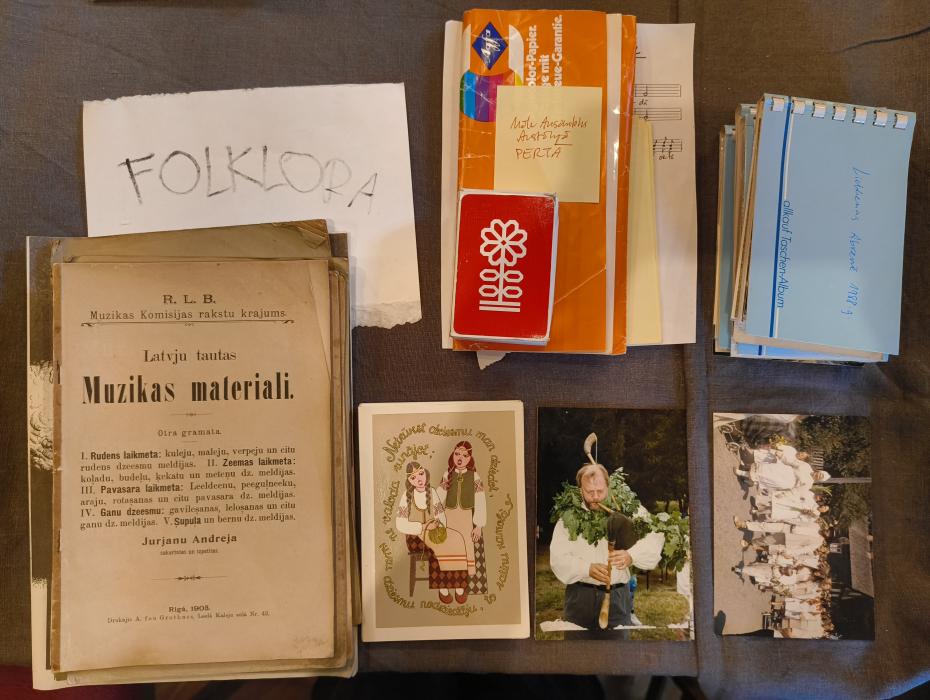
Work is currently underway at Ozolmuiža castle in Limbaži Municipality to study the archive of linguist and folklore researcher Austris Grasis. Since July 21, research assistants Ilga Vālodze Ābelkina and Elvis Friks from the Institue of Literature, Folklore and Art of the University of Latvia, have been working with a vast amount of material, sorting, studying and describing it.
Austris Grasis (1942–2026) was one of the most significant figures in Latvian cultural research and organisation in the Western Latvian exile community, as well as an important figure in the exchange of information between the exile community and participants in the folklore movement in occupied Latvia in the 20th century. In the early 2000s, he returned to his native Latvia, where he continued to preserve folk traditions, turning the “Ģenderti” homestead in Mazsalaca Municipality into a venue for various workshops, seasonal and milestone celebrations, while also bringing to Latvia the archive and library he had assembled throughout his lifetime. A large part of the collection was brought from his former exile property “Abrene” (1987–1995, France). Elvis Friks has described “Abrene” in an entry on literatura.lv HERE.
The library component of the collection consists of books on philology, folkloristics, ethnography and other fields - comprising approximately 30,000 printed works. The remainder of the collection consists of documents, photographs, slides, music publications and other materials, which are the main focus of this project’s research. Particular attention is being paid to the folklore-related materials, which are described as a separate folklore collection within the archive. The resulting dataset will be included in the inventory of folklore materials from exile archives compiled within the framework of the Latvian Council of Science Fundamental and Applied Research Programme project “Latvian Folklore Studies in Exile” (No. lzp-2024/1-0522).
We would like to thank Kristaps Grasis for his responsiveness, assistance in transcribing the materials, and for welcoming us at “Ģenderti”!
The archive is held at Ozolmuiža castle, which is managed by the association “Vienoti mūzikā”. In the long term, the archive is planned to be made more widely accessible to visitors and researchers.
The research of the archive is supported by the State Culture Capital Foundation.