
Registration for the Baltic Summer School of Digital Humanities 2026 is open
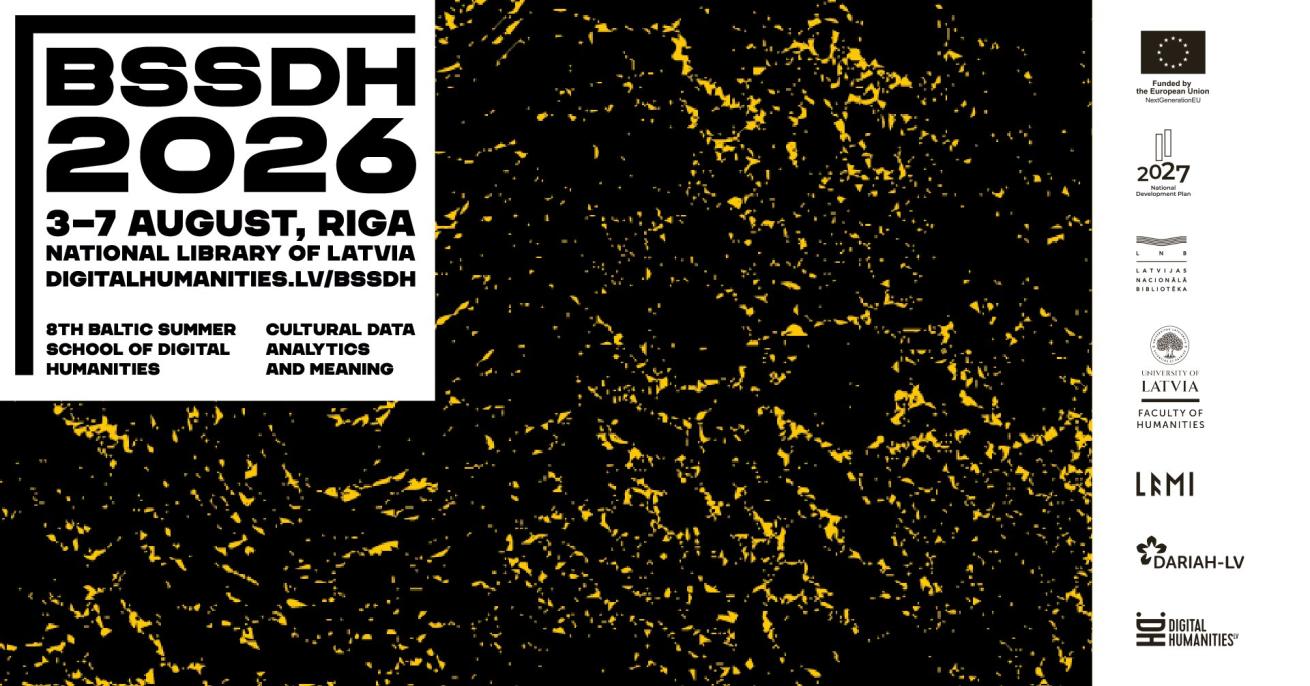
Students, researchers, and GLAM professionals are invited to enrol in the 8th Baltic Summer School of Digital Humanities: Cultural Data Analytics and Meaning, which will take place on 3–7 August 2026 at the National Library of Latvia (NLL).
The registration form for the event is available HERE.
This year, the school is organised as an in-person event; the participation fee for the full course is EUR 60. The keynote lectures will be accessible for free and streamed on the NLL’s Facebook and YouTube channels.
The Baltic Summer School of Digital Humanities is an international intensive continuing education programme that offers researchers, educators, and students in the humanities and social sciences, as well as archive, library, and museum professionals, the opportunity to develop a wide range of digital research skills – from data wrangling and analysis to visualisation.
In this year’s programme, lectures will address the creation of meaning and the interpretation of cultural and humanities data, while workshops will focus on the technical aspects of data preparation, cleaning, modelling, and analysis. Two workshops from last year’s programme – network analysis and working with large language models via API – return in updated form, reflecting their continued importance within the digital humanities toolkit. All sessions are led by experienced practitioners in digital humanities and data analysis.
Workshops:
Lars Kjær – Data Cleaning, Analysis, and Visualization with OpenRefine and Orange
Giovanni Pietro Vitali – Network Analysis for Humanists
Valdis Saulespurēns – Using Large Language Models in Humanities Research via API
Anda Baklāne – Data Visualization for Public-Facing Research
Open lectures:
Aldis Ērglis – Beyond the Canvas: Multimodal Interpretation of Art Masterpieces via Google Nano Banana 2
Tessa Gengnagel – Computer as Archive, Computer as Agent: Tracing the Evolution of the Digital Humanities from the 1960s to an Uncertain Future
Róbert Péter – Decoding 18th-century British Masonic Print Culture: Press Trends, Publication Networks, and Constitutional Authorship Attribution
Sonja Dorfbauer & Simon Mayer – Structured Data Approaches to Historical Collections: Methods and Insights
BSSDH 2026 is organized jointly by the National Library of Latvia, the Faculty of Humanities of the University of Latvia, and the Institute of Literature, Folklore and Art of University of Latvia.