
NAMS working group “Latvian Identity in the Information Age – Formation, Contemporary Developments, and Future Prospects”
Previous studies indicate that “Latvian identity” is perceived in the public sphere as a self-evident concept, without sufficient attention being paid to its precise meaning. In this study, we will address the following question: What are the most essential and stable elements of Latvian identity that can be traced in the past, present, and imagined future, across various environments, contexts, and specific cases? The study will combine methodologies from the history of ideas, philosophy, social anthropology, environmental humanities, and visual ethnography, and will cover five thematic areas:
- The dialogical nature of the formation of Latvian identity – how the Latvian intelligentsia positioned the identity of the emerging Latvian nation in opposition to and alongside the Baltic German intellectual tradition, focusing on the work of educational, scientific, and intellectual institutions in the Baltic German sphere from the mid-19th century to the mid-20th century. We will also examine how identity practices that emerged and developed in the 19th century and early 20th century evolved and transformed within the Republic of Latvia and the Latvian diaspora.
- The political and social applicability of national symbols. We will specifically examine three significant symbols – the Ring of Namejs, the concept of “life wisdom,” and the Latvian national carmine red-white-carmine red flag and its color symbolism.
- The ecological dimensions of Latvian identity – the ways in which environmental themes and motifs are incorporated into the imagination of the ethnic and national community.
- Digital identity as a link between social and personal identity in contemporary Latvia.
- Envisioning the future of Latvian identity. Through an anthropological interview, we will explore how Latvian residents see the future of their national and ethnic identities, thereby engaging in theoretical discussions about the possibilities, imaginations, uncertainties, and hopes that shape contemporary reality.
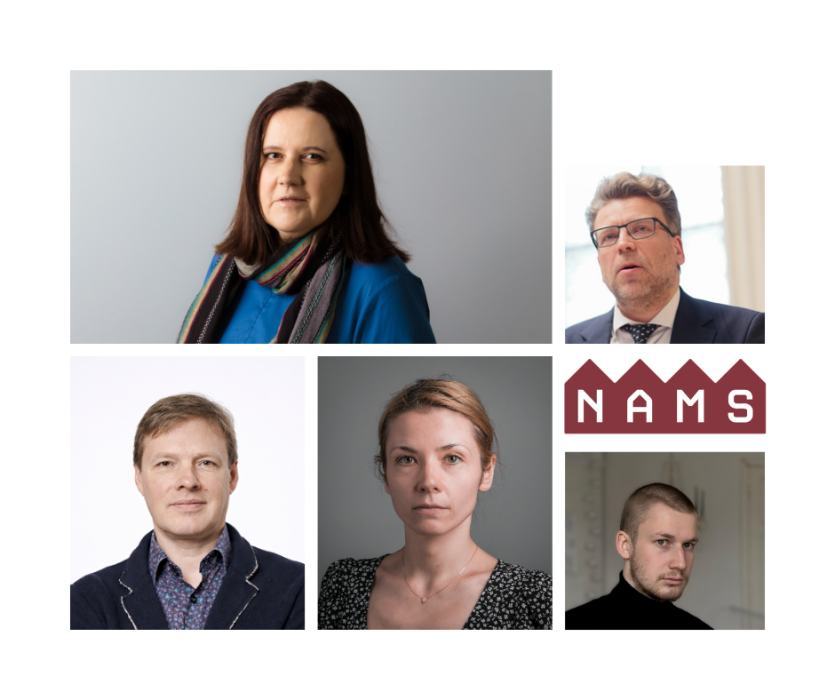
The working group’s research team consists of Agita Misāne, Raivis Bičevskis, Elvīra Šimfa, Klāvs Sedlenieks, and student Tomass Stepiņš.
Project “NAMS. Latvian Identity and Knowledge Strategies as Resources for Societal Resilience” of the State Research Programme “LETONIKA for the Development of a Latvian and European Society” (No. VPP-IZM-LETONIKA-2025/1-0008).