
Issue 57 of the journal “Letonica” has been released
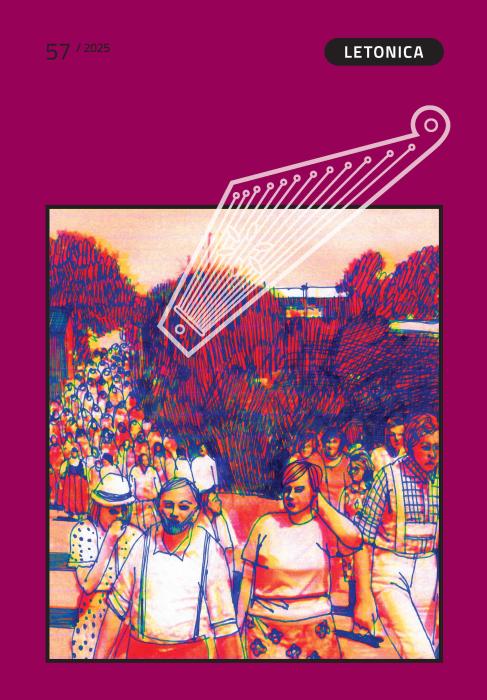
The latest thematic issue of the interdisciplinary scientific journal "Letonica" of the Institute of Literature, Folklore and Art at the University of Latvia (ILFA UL) has been published: “Folklore Revivals in Non-Democracies”, which focuses on folklore revival movements in non-democratic regimes. The issue’s editors are Ieva Vīvere and Digne Ūdre-Lielbārde.
The 1960s–1980s of the 20th century were a time when folklore and folk music revival movements developed in many parts of Europe. This unifying transnational “wave of folklore” emerged under the conditions of the Cold War and the Iron Curtain, and the different political regimes of countries influenced local developments. The aim of this collection of articles is to deepen understanding of the historical specifics of folklore movements in the Soviet Union and its satellite states. The non-democratic, controlled social and political conditions in this region both complicated the efforts of movement participants and also provided additional motivation.
“In implementing the research project ‘Folklore Revival in Latvia: Resources, Ideologies and Practices’, as a joint initiative of Baltic researchers, we organized a panel discussion on folklore revival movements in non-democratic contexts at the SIEF 2023 Congress in Brno, Czech Republic. As a result, for this issue of the journal we received valuable articles from Lithuania, Ukraine, and Hungary, expanding the geographical scope also beyond Latvia,” explains the issue editor Ieva Vīvere regarding the published collection of 13 articles.
The following articles are published in English in the journal: the introductory article “Revivals and Movements in Non-Democracies”, prepared by Ieva Vīvere, Digne Ūdre-Lielbārde, and Ilaria Da Rin Bettina; Toms Ķenčs’ study “Authenticity as Symbolic Capital in the Field of Folklore: A Case Study of Soviet Latvia”; Aina Ramonaite’s article “Tracing the Influence of the Folklore Movement on the Lithuanian National Independence Movement”; Digne Ūdre-Lielbārde’s article “Visualizing Cultural Opposition: The Folklore Movement in Late Soviet Latvia”; Aleida Bertran’s article “Constructing a Theory of Festival Programmes as Manifestos: The International Folklore Festival Baltica during the Singing Revolution (1987–1991)”; Valdis Muktupāvels’ study “Archaization versus Modernization: The Revival of Certain Instrumental Music Traditions in Riga Folklore Ensembles in the Late 1970s and 1980s”; Aigars Lielbārdis’ article “Ethnographic Ensembles in Latvia: From Village to Stage”; Anna Klāra Andor’s work “Diametrically Opposed? The Survival and Revival Possibilities of Interwar Folk Culture Movements under the Communist Dictatorship in Hungary”; Lina Petrošienė’s article “Small Lithuanian Music Folklore in the Soviet Period (1946–1989): Lost Voices and Forms of Revitalization”; Larisa Lukašenko’s study “Prerequisites, Establishment, and Development of Folk Music Revival in Ukraine (Late 1970s – Early 1990s)”; Rita Zara’s article “Guests Beyond the Iron Curtain: Cross-Border Visits of Latvian Folklorists during the Cold War”; Ilga Vālodze Ābelkina’s work “International Folklore Festival Baltica ’88: The Return of Latvian Folk Music from the Diaspora”; and Ieva Vīvere’s article “Transnational Networks of Folk Music Revival Movements: A Methodological Study of the Folklore Ensemble Skandinieki”.
The journal’s editor-in-chief is Jānis Oga. The English-language literary editor is Laine Kristberga. Design was created by Tatjana Raičiņeca.
The issue is funded by the Latvian Council of Science within the framework of the fundamental research project “Folklore Movement in Latvia: Resources, Ideologies and Practices” (No. lzp-2021/1-0243), and published with the support of the University of Latvia and the State Culture Capital Foundation.
Letonica has been published since 1998 and publishes articles in the humanities and social sciences that are original, previously unpublished research based on scientific inquiry. The journal is indexed in Scopus, ERIH PLUS, and EBSCO databases.
- The issue is available online HERE.
- In addition to this issue, an extended online exhibition on the history of the folklore movement in Latvia has been created in Latvian and English HERE.
The latest issues of the journal Letonica can be purchased at LU LFMI (Mūkusalas Street 3 or ordered online HERE), in major bookstores in Latvia, and at the Friends’ Hall of the National Library of Latvia.