
CLARIN–DARIAH Latvian Conference Highlights Developments in Digital Humanities Infrastructures
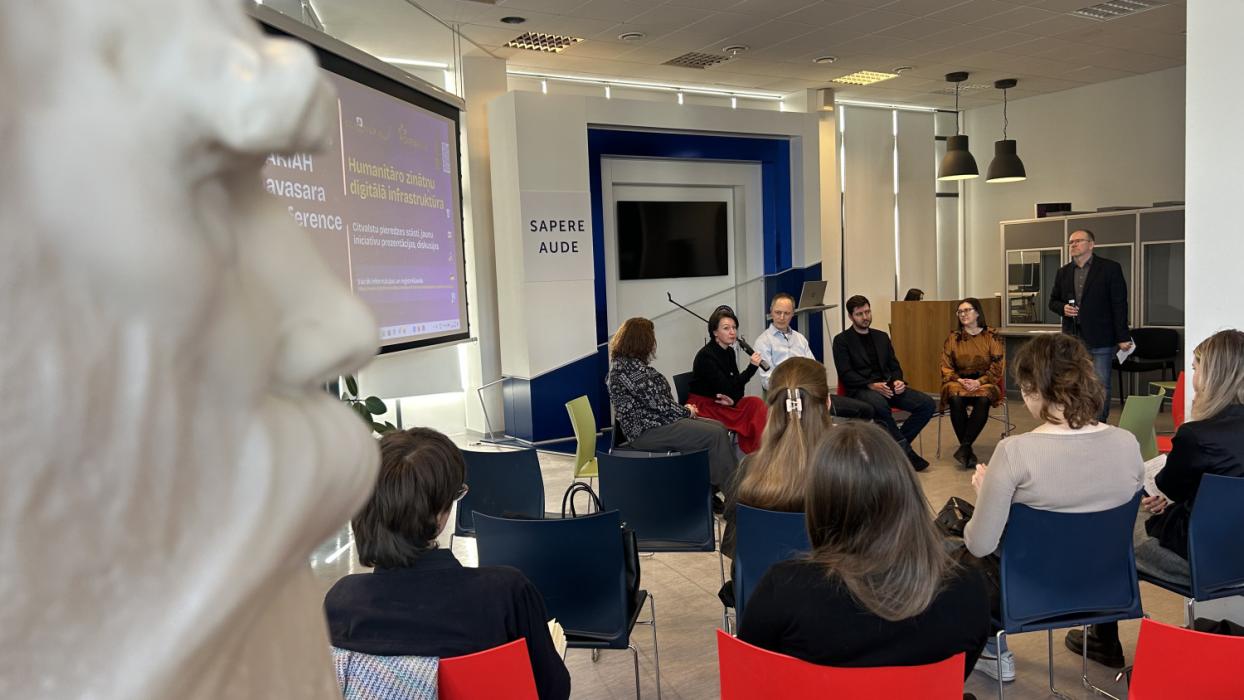
On March 5, 2026, the CLARIN–DARIAH Spring Conference took place, bringing together Latvian and international experts to discuss digital humanities infrastructures, language technologies, and the possibilities of artificial intelligence in research.
The conference was opened by Kaspars Zalāns, Senior Expert at the Department of Higher Education, Science and Innovation of the Ministry of Education and Science of the Republic of Latvia. The first session, chaired by Dāvis Eņģelis, a digital humanities researcher at the Institute of Literature, Folklore and Art of the University of Latvia, focused on the development of language resources and digital infrastructures in Europe and Latvia. Andrius Utka introduced Lithuanian language resources in the age of artificial intelligence and the experience of CLARIN-LT, while Ahmad Kamal provided an overview of DARIAH-SE activities and the development of the Swedish node. Inguna Skadiņa, leading researcher at the Institute of Mathematics and Computer Science of the University of Latvia, reflected on ten years with CLARIN, evaluating achievements and future perspectives. Sanita Reinsone, associate tenured professor at the University of Latvia and head of the Digital Humanities Centre, outlined the path toward establishing DARIAH-LV.
During the coffee break, discussions and demonstrations took place, presenting various digital resources and tools, including the Latvian language morpheme and word-formation model database, the editing corpus Norma, the research data repository DataverseLV, solutions for the digitization and analysis of Latvian folk songs (they were demonstrated by the researchers Ginta Pērle-Sīle, Dāvis Eņģelis, and Linda Barbare of the FLPP project “Spoken Songs: Algorithms of Composition and Improvisation”), an image search tool in the Latvian State Archive of Audiovisual Documents, the speech transcription tool LATE, the use of artificial intelligence in book cataloguing, and the historical dictionary of Latvian personal names.
The second session, chaired by Viesturs Vēveris, a doctoral student in Digital Humanities at the University of Latvia, presented current research projects. Ilze Auziņa, leading researcher at the Institute of Mathematics and Computer Science of the University of Latvia, introduced the national research programme project “Digital Resources and Artificial Intelligence Technologies for the Sustainability of the Latvian Language” (DigiLATE). Sanda Rapa, director of the Latvian Language Institute of the University of Latvia, presented the project “Latvian Language in Time, Space and Society” (LaTS). Uldis Zariņš, director of the University of Latvia Library, spoke about the University of Latvia’s high-impact project “Open Knowledge Ecosystems for the Development of Citizen Science” (OPEN). Anda Baklāne, researcher at the National Library of Latvia, presented updates on the library’s data processing and research infrastructure, with particular emphasis on bibliographic data and the use of artificial intelligence.
The conference concluded with a panel discussion titled “Humanities in the Age of AI: What Do We Expect from Infrastructures?”. The discussion featured Normunds Grūzītis, head of the Artificial Intelligence Laboratory at the Institute of Mathematics and Computer Science of the University of Latvia; Iļja Afanasjevs, chairman of the board of the Shared Service Centre for Information Technologies of Higher Education and Science; Ieva Vīvere, leading researcher at the Institute of Literature, Folklore and Art of the University of Latvia and lead of the project "Spoken Songs: Algorithms of Composition and Improvisation"; Karīna Bandere, director of the Digital Development Department at the National Library of Latvia; and Dace Bušante, director of the Latvian State Archive of Audiovisual Documents. The discussion was moderated by Uldis Zariņš.
The discussion highlighted the importance of digital research infrastructures for the development of the humanities, as well as the need to continue developing language technologies, open data, and inter-institutional cooperation in order to ensure the competitiveness of the humanities and enable the full use of both technology and artificial intelligence potential in the future.
The conference was supported by the project “University of Latvia and Institutes in the European Research Area – Excellence in Research and Collaboration” (No. 1.1.1.5/3/25/I/011).