An overview of research in exile folklore studies
In January 2025, the Institute of Literature, Folklore and Art of the University of Latvia launched the Latvian Council of Science-funded project “Latvian Folklore Studies in Exile” (No. lzp-2024/1-0522), which is now halfway through its implementation. The aim of the project is to explore a part of the history of the field of folkloristics that has not previously been systematically documented – specifically, the work carried out by Latvian scholars and popularisers of science in Sweden, Germany, the United States, Canada, Australia and other countries of residence between 1944 and 1990. In identifying historical sources published and unpublished in exile, researchers and students have joined forces: Rita Zara (project leader), Ilga Vālodze Ābelkina, Inguna Daukste-Silasproģe, Elīna Gailīte, Gatis Ozoliņš, Digne Ūdre-Lielbārde and Viesturs Zanders. As there is much work to be done, the involvement of volunteer students from the Latvian Academy of Culture and the University of Latvia has also been significant: Justīne Jaudzema, Elvis Friks, Dace Krecere-Vule and Anete Marija Tamane deserve our gratitude.
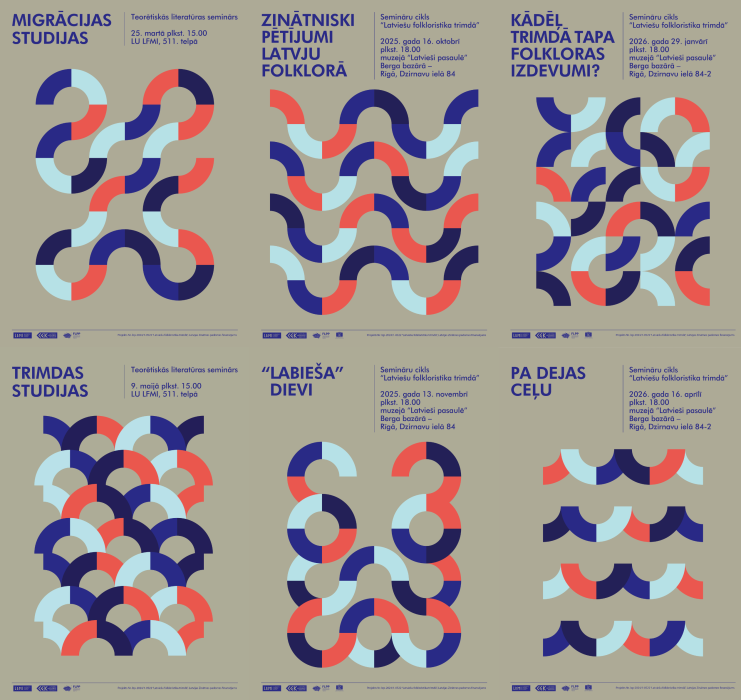
The project’s activities are organised into four work packages: 1. “Project management”; 2. “Identification and creation of historiographical sources”; 3. “Analysis of the data obtained”; 4. “Public outreach”. In accordance with the project’s methodological and theoretical framework, several workshops were organised during the first months of the project, strengthening the capacity of the research group and inviting representatives of other humanities and social science disciplines to become acquainted with new approaches to historical research. The project group prepared for the forthcoming data extraction work during the practical seminars “Obtaining bibliographic data and bibliographic reference systems” and “Identification of unpublished sources”. Meanwhile, theoretical literature seminars were held in a wider group: “Migration Studies” (25 March 2025) and “Exile Studies” (9 May 2025).
With the aim of creating a research base not only for the current studies of the research group, but also for diverse research into Latvian exile culture in the future, the identification of printed historical records of folkloristics and archival sources is under way. In the field of publishing, Benjamiņš Jēgers major work “Bibliography of Latvian Exile Publications” (1968-1994, Vols. 1-5) has been of immense assistance. In researching the press, the digitised exile publications of the National Library of Latvia available on the periodika.lv website have proved useful. Meanwhile, the identification of archival materials requires both careful examination of museum catalogues and research work in memory institutions. Valuable materials have been found not only in Latvia - many exile collections have travelled here - but also at The Nordic Museum in Stockholm, the Latvian Centre in Münster, and the ALA Latvian Museum in the United States. It has been possible to carry out more thorough archival research thanks to additional support - the Liene Neulande Foundation scholarship of Stockholm University awarded to Rita Zara, as well as the support of the State Culture Capital Foundation awarded to Ilga Vālodze Ābelkina. In response to an appeal in diaspora media, we have made contact with the family of folklorist Aija Veldre-Beldava (1941–2009), and have also received a valuable donation from Iveta Asons in the United States - materials of the Latvian Folk Dance Association, which form the collection LFK [2281], and the archive collection of the folk dance group “Jautrais pāris” in LFK [2282]. Alongside this, the researchers have interviewed former members of Latvian exile community: the interviews conducted during the project have been included in the collection LFK [2250] “Archives of Latvian Folklore Interviews”. In 2027, this joint work will result in an analytical report “Bibliographical and archival sources for Latvian folklore studies in exile”, and the collected data - structured information on materials found in printed publications and memory institutions - will be available to anyone interested.
On the one hand, the project seeks to provide a panoramic overview of Latvian folklore studies in exile. On the other hand, each researcher has their own specific areas of interest, which are analysed in scholarly articles, popular science publications, academic papers and other public presentations. In cooperation with the Museum “Latvians Abroad”, a series of four public seminars was held, offering visitors to gain an insight into the diverse themes of the research: national identity and humour in the journal “Jaunā Gaita” (16 October 2025), folklore publications in exile (29 January 2026), the Dievturi journal “Labietis” (13 November 2025), and the journal “Pa Dejas Ceļu” (16 April 2026). The researchers have presented papers both in Latvia (the 83rd International Scientific Conference of the University of Latvia, the conference of the Faculty of Humanities of the University of Latvia “100 Years of Exile Writer Aivars Ruņģis”) and abroad (the 16th SIEF Congress in Aberdeen, the 11th Annual Conference of the Centre for Baltic and East European Studies at Södertörn University in Stockholm). One academic lecture has already been given to students at the University of Latvia, while in the autumn of 2026 the project’s researchers will visit students at the University of Tartu, the University of Greifswald and the University of Warsaw.
Over the next year and a half, the “Latvian Folklore Studies in Exile” team will also offer several other public activities: an online survey is forthcoming, in which we will specifically reach out to former exiles as well as diaspora communities, and a virtual exhibition, which will be published on the website of the Archives of Latvian Folklore at lfk.lv. The project is also expected to make a substantial academic contribution upon its conclusion - the research results will be published in scholarly articles.
Information prepared by:
Rita Zara