
Research on the history of Latvian women.
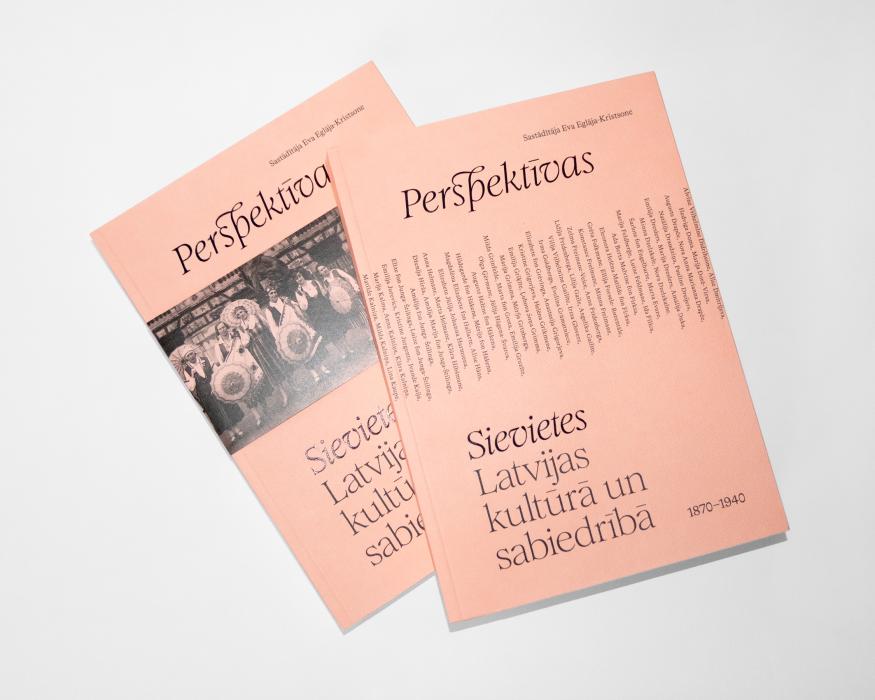
The publishing house of the Institute of Literature, Folklore and Art at the University of Latvia has released the collective monograph Perspektīvas. Sievietes Latvijas kultūrā un sabiedrībā 1870–1940 (Perspectives: Women in Latvian Culture and Society, 1870–1940). This joint work sheds light on significant processes in Latvian history that have not yet been sufficiently researched, especially regarding women’s role in shaping society and culture.
The volume is compiled by literary scholar Eva Eglāja-Kristsone together with a team of authors: art historian Baiba Vanaga, literary scholars Māra Grudule and Zita Kārkla, and historians Ineta Lipša, Rasa Pārpuce-Blauma, and Guntis Vāveris. Their study examines women’s agency in culture and society from 1870 to 1940. The book was designed by Una Grants.
Commenting on the idea and significance of the monograph, Eva Eglāja-Kristsone emphasizes:
“The themes and stories explored in this book are part of a broad field that is still insufficiently researched. By bringing these experiences to light, we hope to inspire further studies of women’s diverse contributions and to connect them with global women’s history research. The title Perspectives carries a double meaning: it refers both to the different scholarly viewpoints and to the women discussed in the book themselves as ‘perspectives’—promising and active in their professional and public lives. Alongside well-known figures, the book also brings in names and works that have so far been forgotten or only mentioned in passing.”
The monograph covers women’s participation in art, literature and translation, Baltic German press debates on emancipation, and women’s civic and political activity, including the temperance movement, philanthropy, and parliamentary politics. Bringing together biographical, interdisciplinary, and intersectional perspectives, it shows how women from different social and ethnic groups influenced Latvian culture, the public sphere, and the emergence of a democratic society. The chapters are complemented by extensive visual material, as well as the compiler’s introductory chapter on the development of women’s history as a field, linking international debates with Latvian examples and the local institutional context. The volume also includes an index of persons, a bibliography, and an English-language summary.
Professor Vita Zelče describes the publication as “a necessary and valuable book,” noting that it not only introduces new knowledge, facts, and historical actors into public circulation, but also encourages reflection and debate about how fair and complete many established narratives of Latvia’s past have been, from which women’s history has been, and still is, lost. She adds that the book offers “a compelling account of Latvian women’s resilience, intelligence, initiative, courage, humility, setbacks, and the historical framework of their lives and work.”
The research was carried out within the Latvian Science Council’s Fundamental and Applied Research Project (FLPP), No. lzp-2020/1-0215, Women’s Representation in Latvian Culture and Society (1870–1940).
Publication of the book was supported by the State Culture Capital Foundation and the Riga City Municipality.