
Literary scholar Dzidra Vārdaune has passed away (06.06.1928–23.10.2023)
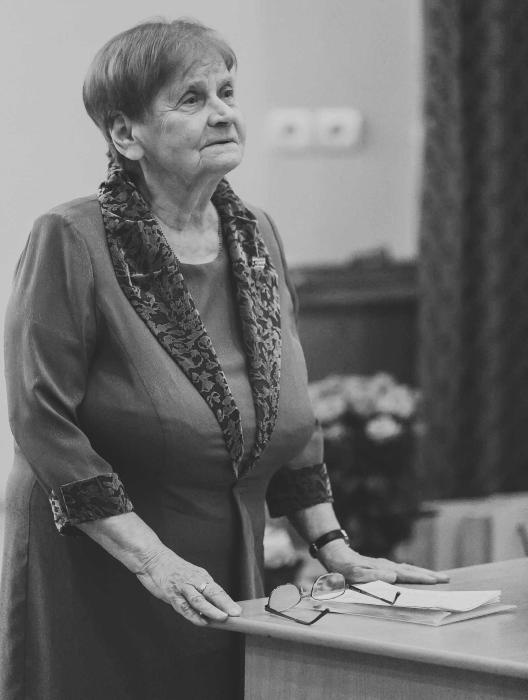
While working at the Institute of Literature, Folklore and Art (1957–2000; the institute had various names over time), Dzidra Vārdaune focused her scholarly interests on drama theory (The Genre of Tragedy in Latvian Literature, 1973). She wrote on monologue and dialogue in drama and studied the work of individual playwrights, including Jānis Jurkāns and Gunārs Priede. She also researched short prose genres—essays and miniatures (in the co-authored volume Prose Genres, 1991). Vārdaune produced portrait studies of Māra Zālīte, Māra Misiņa, Andrejs Eglītis, and Māris Čaklais. She compiled Andrejs Eglītis’s Collected Works in seven volumes (2002–2006) and Māris Čaklais’s Collected Works (vols. 1–2, 2017–2020; volume 3 prepared for publication).
“In literary studies, Dzidra Vārdaune belongs among those rare exceptions for whom there are no barriers between genres and literary forms. Her professional contribution is significant not only in the fields of drama and prose, but also poetry. […] The ability to immerse herself in poetic material and to ‘decode’ the mystery of a poetic image—and at the same time the author’s talent—in clear, pure language unburdened by fashionable loanwords, is perhaps one of the key indicators of her success. And also the ability to master material and discipline thought,” wrote literary scholar Broņislavs Tabūns.
The Institute of Literature, Folklore and Art of the University of Latvia extends its deepest condolences to the family of Dzidra Vārdaune.
The farewell ceremony for Dzidra Vārdaune will take place on Saturday, 28 October, at 12:00, in the Great Hall of the Riga Crematorium.
“Dear Dzidra,
All words seem too small to express what I feel. We tend to think our parents and close friends will be eternal, untouched by the relentless rhythm of life. Departure and you—these seem incompatible. You possessed immense life force (I avoid the word ‘vitality’, as you always smiled at excessive use of foreign words). You overcame life’s complexities (only you know what it cost you), preserving love and leaving no room for destructive emotions. Love for your son and family, for close people, colleagues, literature, theatre, and music—this formed your world, which now remains in our memories and in your work. Thank you for forty years of friendship, trust, the ability to listen, our shared paths and conversations, for seriousness and sadness, for laughter and an undying sense of humour.”
— Ieva Kalniņa
“Dzidra Vārdaune was a wise, refined, and empathetic literary scholar, able to look into the nuances of writers’ souls and discern their manifestations in texts. A discerning, understanding, and benevolent colleague who helped many newcomers find their place in the institute’s community of literary scholars.”
— Anita Rožkalne
“Dzidra Vārdaune possessed something that could be called a celebration of life. Most of all, it showed in her sense of humour and her ever-curious, lively interest in everything encountered in life and literature.”
— Benedikts Kalnačs
“I think colleagues from other fields at the institute knew Dzidra as a source of sparkling wit and laughter. I was surprised by her recent invitation to become Facebook friends :).”
— Dace Bula
“Heartfelt thanks for sharing memories of youth while leafing through old photo albums and looking back at half-grown, long-unwalked paths and trails in the history of family and institute alike. May your journey into eternity be bright.”
— Māra Grudule
“To friends and colleagues, Dzidra Vārdaune was ‘Dzidriņa’, extending a hand across times and generations at a level of understanding where a long, rich life and experience and first realizations in younger years carried equal weight. In conversations with Dzidriņa, the gap of years was bridged by the joy of discovery—books, music, theatre, cinema, interviews with contemporaries. This joy, as in life, alternated with surprise and disappointment over the reasons and consequences of human actions—nearby and across the world—but even then bitterness was soon washed away by humour and laughter. Though she wrote perceptive and precise essays on our great poets and playwrights, she shyly and modestly avoided meetings and conversations with literary figures. I believe it was through integrity and tact that she unlocked for us the work of Andrejs Eglītis, Māris Čaklais, and other poets. Dzidriņa’s interest in what was happening around her was astonishing and remained until the very end, as did her ability to ease physical pain through work—managing to organize and comment on volume 3 of Māris Čaklais’s Collected Works, soon to be published by the LU LFMI press, while hoping to continue what she had begun. Thank you, Dzidriņa, for friendship, faith, and trust. Bright memory!”
— Jānis Oga
Photo: Māris Lazdāns