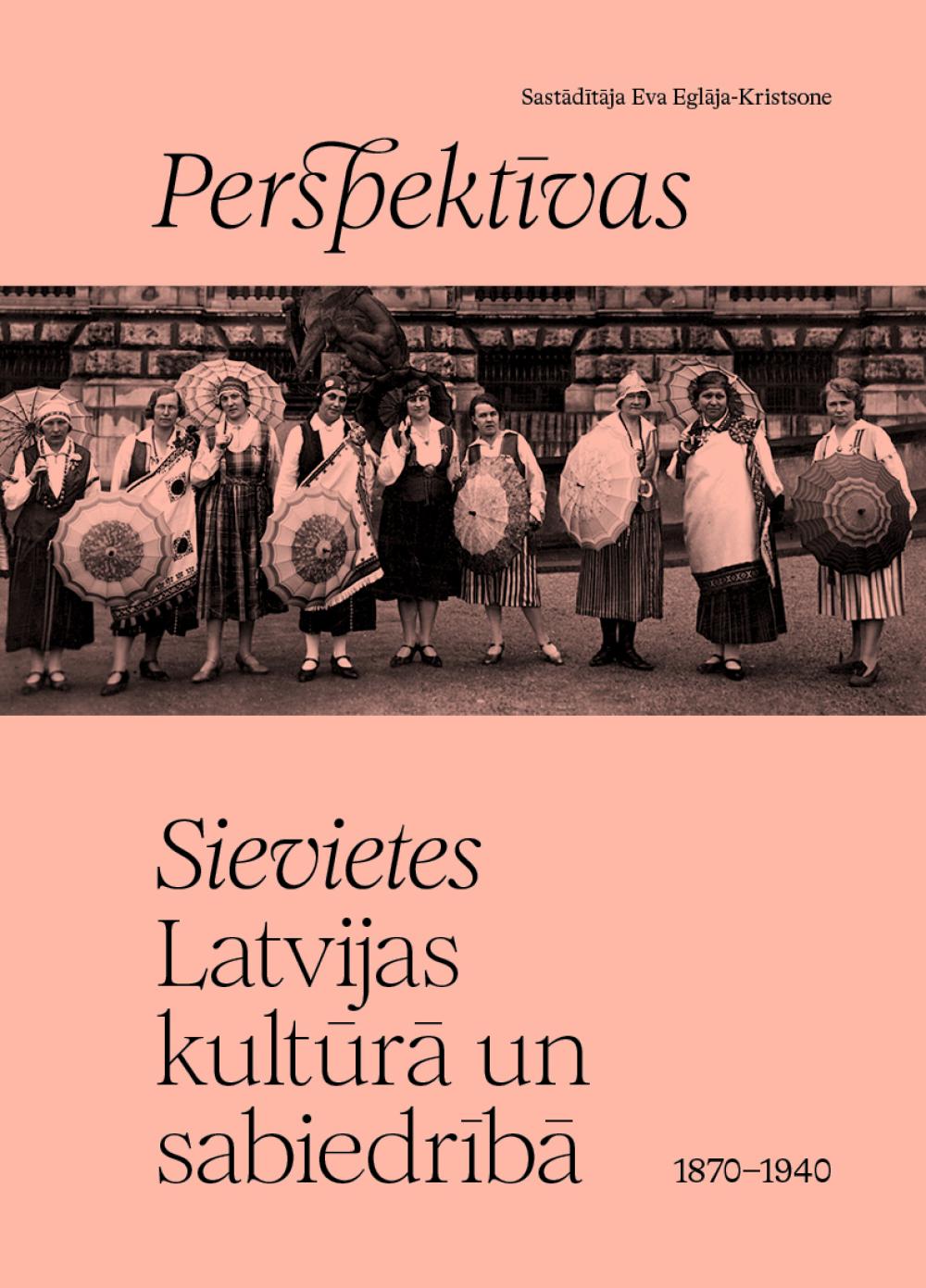
Edited by Eva Eglāja-Kristsone and published by the Institute of Literature, Folklore, and Art at the University of Latvia, this volume brings together leading gender studies, history, literature, and cultural research to re-evaluate women’s agency during a pivotal period of nation-building and modernisation. The publication of Perspectives coincides with a significant anniversary: one hundred years ago, on 26–27 September 1925, the First Latvian Women’s Congress was held and the Latvian Council of Women’s Organisations was established. This milestone represented a significant step towards greater women's involvement in the legislative process and in shaping public opinion. Through synthesising biographical studies, social analysis and cultural critique, the book deepens our understanding of women’s roles in shaping Latvian modernity, challenging long-standing historiographical assumptions about their participation in cultural and political transformations.
The monograph is structured into seven chapters, each offering a nuanced exploration of women’s cultural, political, and social engagement in Latvia. Rather than merely compiling historical case studies, Perspectives serves as a call to reassess established narratives of Latvian history and historiography critically. It challenges the notion that women’s history is a separate or peripheral field, instead asserting its centrality to broader societal transformations. Through its interdisciplinary and methodologically innovative approach, the volume offers a multidimensional account of women’s resilience, agency, and influence, bridging the personal and the collective, as well as the local and the transnational.
-
Eva Eglāja-Kristsone, “Women’s History between the Public, the Private, and the Political”
This chapter provides the conceptual and historiographical framework for the volume, showing how the public/private divide was historically produced and used to sustain gender hierarchies. Drawing on key debates in women’s and gender history (for example, Gerda Lerner and Joan W. Scott), it traces the development of women’s history in Latvia from early documentation to post-Soviet feminist scholarship, highlighting “in-between” spaces where women built civic competence and authority.
-
Baiba Vanaga, “Women Artists’ Positioning in Local Art Life”
The chapter reconstructs women’s artistic authorship in Latvia from the late nineteenth century to the interwar period by analysing training systems, exhibition circuits, criticism, and collecting practices that shaped visibility and later canon formation. Through empirically grounded case studies (including Elise von Jung-Stilling, Emīlija Gruzīte, Ljubow Sonja Grimm, and Nora Drapče), it argues for women’s art as an infrastructural part of Latvian modernism, not an add-on to a male-led narrative.
-
Rasa Pārpuce-Blauma, “Women for Women: Women’s Emancipation Discourse in Latvian German Periodicals”
This chapter examines how German-language periodicals in the Baltic provinces (from the 1870s to 1914) constructed, constrained, and enabled women’s emancipation discourse through editorial strategies, terminology, and respectability politics. Combining discourse analysis with biographical micro-studies, it shows women acting as editors, authors, translators, and organisers while building a pragmatic public sphere shaped by conservatism, empire, and transnational feminist currents.
-
Māra Grudule, “Bridges and Parallels: Baltic German Women and the German Translations of Latvian Folksongs”
The chapter reframes translation as cultural brokerage by analysing four Baltic German women’s German renditions of Latvian dainas (Lizette Harmsen, Inga Bielenstein, Elise von Keyserling, and Elly von Fircks). Through close reading of translation strategies (metre, parallelism, mythonyms, diminutives) and reception, it demonstrates how social position and aesthetic ideology produced distinct programmes of transfer, ranging from nostalgic domestication to modernist refunctionalisation.
-
Zita Kārkla, “Landscapes of Complex Feelings: Women’s Mobility and Emotional Geographies in the Early 20th Century”
This chapter interprets Latvian women’s travel writing as a site where mobility generates modern female subjectivity and reorganises emotion as a spatial practice. Focusing on Antija (Antonija Melnalksne), Anna Rūmane-Ķeniņa, and Ivande Kaija, it shows how journeys, shaped by work, leisure, and literary vocation, produce emotional geographies that contest confinement and renegotiate the boundaries of agency.
-
Guntis Vāveris, “Society and Alcohol in Latvia: Women’s Opportunities for Agency in the Temperance Movement”
The chapter presents temperance as a gendered infrastructure of civic modernity, where women developed organisational skills, public voice, and networks that could extend into broader political arenas. Using association records, periodicals, and archives, it traces how women’s leadership expanded through lecture circuits and international links, yet became increasingly constrained by maternalist and nationalist scripts in the 1930s.
-
Ineta Lipša, “Women’s Candidacy in Saeima Elections (1922–1934) and the Work of Female Deputies in the Fourth Saeima”
This chapter reconstructs women’s parliamentary agency in interwar Latvia through electoral mechanics, party politics, and case studies of Milda Salnā, Aspazija, and Berta Pīpiņa. It argues that flexible-list voting systematically reduced women’s representation, while women’s organisations responded with targeted political education, and it culminates in a detailed account of how Pīpiņa translated movement experience into legislative work.